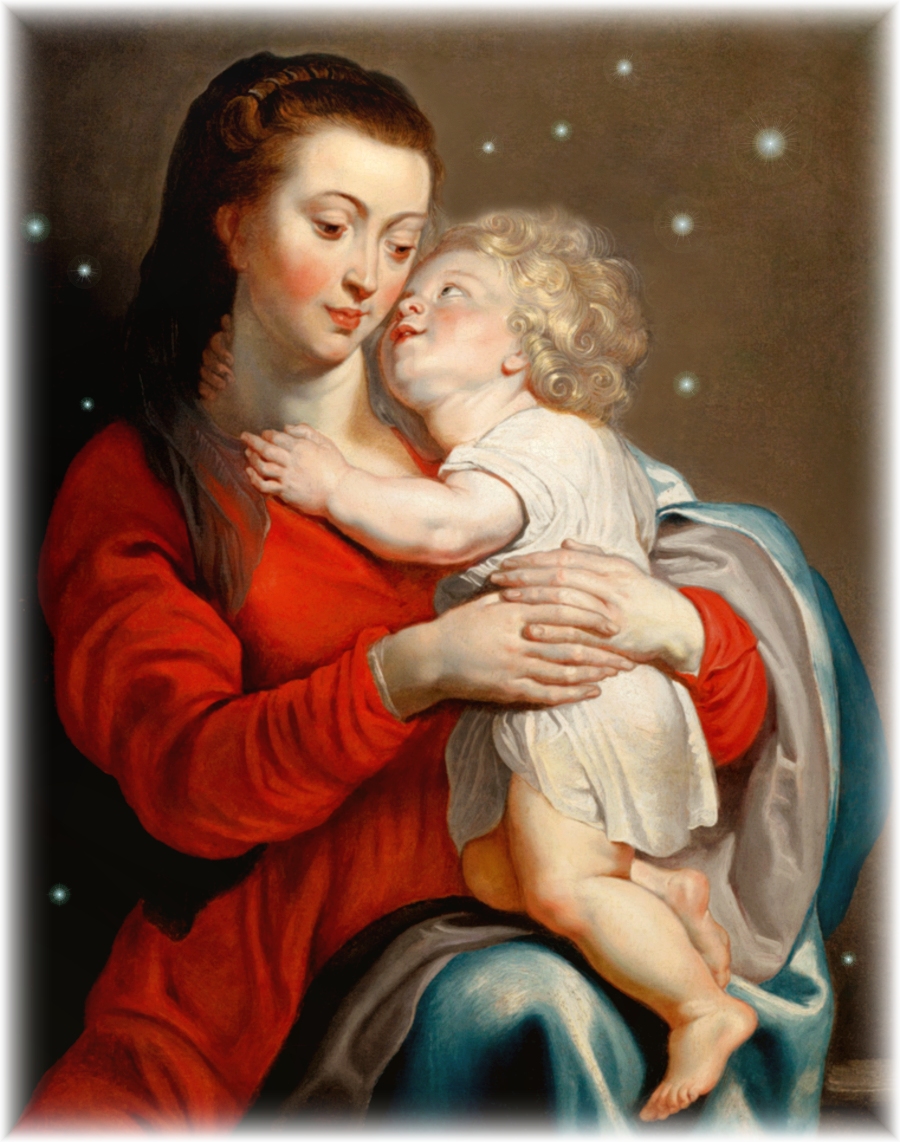

The Mother of the Savior
FROM THE BOOK OF THE ABOVE TITLE BY
Fr. Reginald Garrigou-Lagrange, O. P.
Nihil Obstat and Imprimi Potest 1941 and 1948
TAN BOOKS

| Taken
from Part 1 The Divine Maternity and the Plenitude of Grace, Article V The Consequence of Mary's Plenitude of Grace From the instant of her conception, Mary's initial plenitude of grace included the infused virtues and the seven gifts of the Holy Ghost, which are the different parts or functions of the spiritual organism. Even from before St. Thomas's time, habitual grace was called 'the grace of the virtues and the gifts' because of its connection with them; for the infused virtues, theological and moral, flow from grace (in a degree proportioned to its perfection) as its properties, just as the faculties flow from the substance of the soul. [24] The gifts flow from it also (in a similar proportionate degree) as infused permanent dispositions which make the soul docile to the inspirations of the Holy Ghost, somewhat as the sails of a boat make it docile to a favorable wind. [25] Furthermore, the infused virtues and the gifts are linked up with charity which makes their acts meritorious, [26] and they keep pace with it in their growth as do the five fingers of the hand with one another. [27] It may well happen that the gifts of wisdom, understanding and knowledge, which are both speculative and practical, will manifest themselves in one Saint more in their practical and in another more in their speculative roles. But normally all seven exist in every soul in the state of grace in a degree proportionate to its charity-----the charity itself being proportionate to the sanctifying grace of the soul. From these principles, which are commonly accepted in treatises on the virtues in general and the gifts, it is usually deduced that Mary had the infused theological and moral virtues and the gifts from the first instant of her conception, and that they flowed from and were proportionate to her initial fulness of grace. Mary-----destined even then to be Mother of God and men-----could not have been less perfect than Eve was at her creation. Even if she did not receive in her body the privileges of impassibility and immortality, she must have had in her soul all that pertained spiritually to the state of original justice-----all, and more, even, since her initial fulness of grace surpassed the grace of all the Saints together. Her virtues in their initial state must, therefore, have surpassed the heroic virtues of the greatest Saints. [28] Her faith, lit up by the gifts of wisdom, understanding and knowledge, was unshakably firm and most penetrating. Her hope was unconquerable, proof against presumption and despair alike. Her charity was most ardent. In fine, her initial holiness, which surpassed that of God's greatest servants, was born with her, and did not cease to grow all through life. The only difficulty in this matter is that of the exercise of the infused virtues, already so perfect, and the gifts. Their exercise demands the use of reason and of free will. We must, therefore, ask if Mary had the use of her rational faculties from the first instant. All theologians admit that the holy soul of Christ had the use of intellect and will from the beginning. [29] They admit too that He had the Beatific Vision, or the immediate vision of the Divine Essence, [30] a doctrine which the Holy Office declared on June 6th, 1918, to be certain. Jesus is the Head in the order of grace, and therefore He enjoyed from the first instant, as a consequence of the personal union of His humanity to the Word, the glory He was to give to the elect. He had also infused knowledge similar to that of the angels, but in a much more perfect degree than it has been found in some of the Saints-----in those, for example, who had the gift of understanding and speaking languages they had never learned. [31] Theologians teach that these two knowledges-----the Beatific Vision and the infused-----were perfect in Jesus from the beginning. It was only the knowledge which He acquired by experience and reflection which developed. Jesus, the sovereign priest, judge, and king of the universe, offered Himself for us, says St. Paul, [32] from the moment of His entry into the world and knew everything in the past, present and future, that could be submitted to His judgment. [33] Though there is little serious difference of opinion among theologians regarding Jesus' knowledge, the problem of Mary's knowledge is much disputed. It would appear that there is no reason to assert that she had the Beatific Vision here on earth, especially from the first instant of her conception. [34] But many theologians hold that she had per se infused knowledge from the beginning, at least from time to time-----though some contend that she had it in a permanent way. On this view she would have had the use of her intellect and of her free will in her mother's womb-----on certain occasions at least-----and would, in consequence, have had the use of the infused virtues and the gifts which she possessed in so high a degree. One can hardly deny this view except by asserting that Mary's intellect, will and infused virtues remained as it were asleep, as they do in other children, and did not wake up till she attained the ordinary age of the use of reason. For our part, we may say, first of all, that it is at least very probable, according to the teaching of the majority of theologians, that Mary had the use of her free will through her infused knowledge from the first instant of her conception, at least in a passing manner. Such is the teaching of St. Vincent Ferrer, [35] St. Bernardine of Sienna, [36] St. Francis de Sales, [37] St. Alphonsus, [38] Suarez, [39] Vega, [40] Contenson, [41] Justin de Miechow, [42] and most modem theologians. [43] Fr. Terrien goes so far as to say that he found only two opponents of the doctrine: Gerson and Muratori. [44] The following are the reasons that can be adduced in favor of the privilege: 1st----It is not becoming to hold that Mary, Queen of patriarchs, prophets, Apostles, and all the Saints, lacked a privilege granted to St. John the Baptist. [45] We read of him in Luke i, 41 and 44, while he was still in the womb: 'When Elisabeth heard the salutation of Mary, the infant leaped in her womb', and Elisabeth herself said: 'For as soon as the voice of thy salutation sounded in my ears, the infant in my womb leaped for joy.' St. Irenaeus, St. Ambrose, St. Leo the Great, and St. Gregory the Great have noted that the joy of St. John the Baptist before his birth was not merely of the sense order, but was elicited by the coming of the Savior, Whose precursor he was. [46] Thus Catejan notes that this joy, being a spiritual order, presupposes the use of reason and will, and at the time there could be no question of acquired but only of infused knowledge (Comment. in ilia P., q. 27, a. 6). The Church too sings in her liturgy, in the hymn for Vespers of St. John the Baptist 'Senseras Regem thalamo manentem . . . Suae regenerationis cognovit auctorem: You have recognized your kind and the author of your regeneration.' If, therefore, St. John the Baptist had the use of reason and will before birth, because of his vocation as precursor of Christ, the same privilege can hardly be denied to Christ's mother. 2nd----Since Mary received grace and the infused virtues and the gifts in the first instant in a degree higher than that of the final grace of the Saints, she must have been sanctified in the way proper to adults, that is, by disposing her through actual grace for habitual grace, and by using this latter as a principle of merit from the moment she received it; in other words, she offered herself to God as her Son did on His entry into the world. 'Then I said: Behold I come to do thy will, O God' (Hebrews x, 9). Mary did not, of course, know then that she would be one day the Mother of God, but none the less she would accept all that the Lord asked and would yet ask of her. 3rd----Mary's initial fulness of grace, virtues, and gifts which surpassed already the final fulness of all the Saints, could not have remained inactive at the beginning of her life. Such inactivity would appear opposed to the sweet and generous dispositions of Divine Providence in favor of the Mother of the Savior. But unless she had the use of her free will through infused knowledge, the virtues and gifts which she possessed in so high a degree would have remained inactive for a considerable part of her life (that is, the beginning). Almost all present-day theologians admit that it is at least very probable that, in her mother's womb, Mary had the use of her free will through infused knowledge----transitorily, at any rate. They admit too that she had the use of this infused knowledge on certain occasions, such as the Incarnation, the Passion, the Resurrection, the Ascension; also that she had the use of it for the purpose of acquiring a more perfect knowledge of the Divine perfections and of the mystery of the Blessed Trinity. There is all the more reason for admitting that Mary had this privilege when we recall that infused knowledge was given to the Apostles on the first Pentecost when they received the gift of tongues, and that the great St. Teresa, after arriving at the Seventh Mansion, had frequent intellectual visions of the Trinity such as can only be explained by infused ideas. Even those theologians who are most conservative in their views do not hesitate to admit this much of Mary. [47] It is in fact the least that may be attributed to the Mother of God who enjoyed the visit of the Archangel Gabriel, who was on terms of saintly familiarity with the Incarnate Word, who was constantly enlightened by Him during the hidden life, who must have received special revelations during and after the Passion, and who received on the day of Pentecost the light of the Holy Ghost in more abundant measure than the apostles themselves. Was Mary's Use of Reason and Free Will in her Mother's Womb only Transitory and Interrupted? According to St. Francis de Sales, [48] St. Alphonsus, [49] and theologians of the standing of Sauv é, [50] Terrien [51] and Hugon, [52] Mary's use of her privilege was uninterrupted. Fr. Merkelbach and other theologians assert that there is no convincing argument in proof of that thesis. [53] It is our opinion that though it cannot be demonstrated with certainty that Mary enjoyed the uninterrupted use of reason and free will in her mother's womb, it is seriously probable and difficult to disprove that she had it. For if it be conceded that she had it in the first instant, it follows that she would become less perfect when deprived of it. But it does not appear becoming that so holy a creature should fall in any way without guilt on her part, all the more so since her dignity demanded that she should progress continuously and that her merit should be unbroken. [54] It has been objected that St. Thomas regards the privilege as peculiar to Christ. [55] Certain it is that Christ's permanent exercise of reason and will belongs to Him alone as a strict right and consequence of the beatific vision. Mary cannot lay any such claim to the privilege. But it appears altogether becoming that the future Mother of God should have been granted it as a special and most appropriate favor. Besides, St. Thomas's words may be explained by the fact that the Immaculate Conception had not been defined in his time and, in consequence, prominence had not been given to the motives we have adduced for admitting the privilege in Mary's case. [56] Today, however, after the Bull Ineffabilis, we realize that Mary was favored from the first instant more than all the saints united. Besides, as we have said, almost all theologians admit that she had the privilege at least transitorily from the first instant. If so, it is hard to see why it should ever have been withdrawn, interrupting her merit and progress, and leaving the initial plenitude, as it were, unproductive and sterile -----all of which is opposed to the sweet and strong way in which Providence cared for Mary. Such was the initial fulness of grace which accompanied the Immaculate Conception, and such were its first consequences. More and more can we see the implications of the angelic salutation: 'Hail, full of grace.' 24. Cf. Ia, IIae,
qq. 62, 63 (a. 3),
110, aa. 3
and 4; IIIa, q. 7, a. 2. 28. Cf. H. B. Merkelbach, Mariologia, 1939, pp. 184-194. 35. Manuscript.
Tolos., 346. 46. St. Irenaeus, Adv. Haer.III, 16; P. G., VIII,
923: 'John who was still in his mother's womb, recognizing the Savior
Who was in Mary's womb, saluted Him'; St. Ambrose, in Luke I, II, c.
xxxiv; P. L., LN, 232: 'He who thus leaped for joy had the use of
reason'; St. Leo, Sermo x.xXI in
Nativ. Domini, c. iv; P. L., LN, 232: 'The precursor of Christ
received the prophetic spirit in the womb of his mother, and before his
birth manifested his joy in the presence of the Mother of God'; St.
Gregory, Moral., I. III, c.
4; P. L., LXXV, 603: 'He was filled with the prophetic spirit in the
womb of his mother.' 48. Loc. cit. 49. Loc. cit. 50. Jesus Intime, t. III, p. 262. 51. La Mere de Dieu, t. II, ch. I. 52. Tractatus Dogmatici, 1927, t. II, p. 759; also Marie Pleine de Grace, 5th edit., 1926, pp. 24-32. 53. Mariologia, pp. 199, 201. 54. This is the argument of Fr. Hugon, loco cit. 55. IIIa, q. 27, a. 3: '. . . non habuit usum liberi arbitrii in ventre matris existens: hoc enim est speciale privilegium Christi. . . .' 56. Cf. Hugon, locis citis. God the holy
Ghost gives us His Seven Gifts, which help us to follow His
inspirations and
which strengthen our natural powers so that we see better and act with
more strength. These Gifts are Knowledge, Understanding, Wisdom and
Counsel, which enlighten and help the intelligence, and Fortitude,
Piety and Fear of the Lord, which strengthen our wills.----WEB
MASTER. |
 E-MAIL
HOME---------------------------------------------MARY'S INDEX
www.catholictradition.org/Mary/mother-savior13.htm