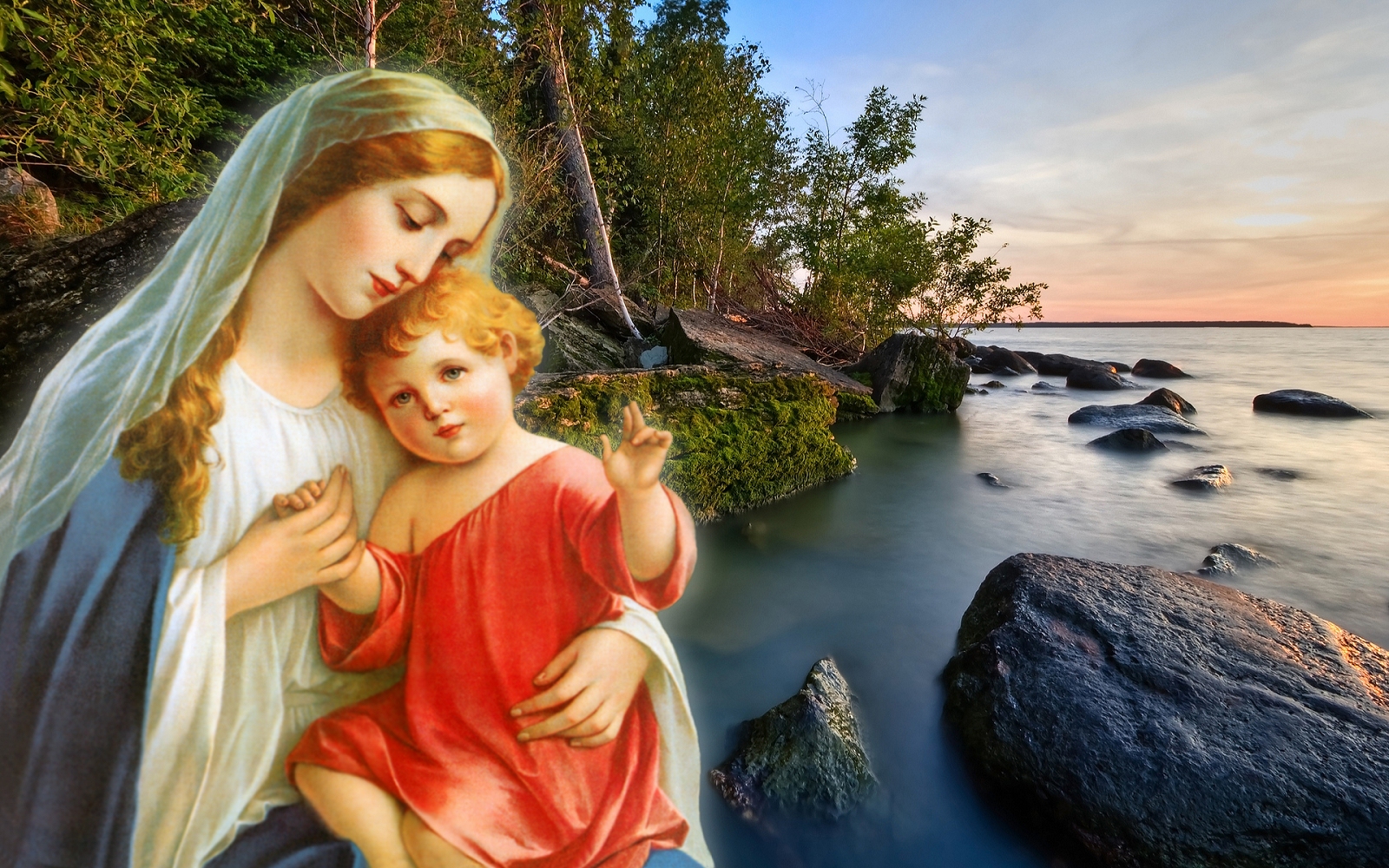

The Mother of the Savior
FROM THE BOOK OF THE ABOVE TITLE BY
Fr. Reginald Garrigou-Lagrange, O. P.
Nihil Obstat and Imprimi Potest 1941 and 1948
TAN BOOKS

| Taken
from Part 2 Mary, the Mother of All Men, Her Universal Mediation and Our Interior Life, Article II Mary and the Distribution of Grace Does Our Lady distribute grace only in the sense that she intercedes for each one of us and so obtains that the fruits of the merits of her Son be applied to each one of us at the appropriate moment, or does she transmit graces to us in the way in which the Sacred Humanity does? According to the teaching of St. Thomas and many other theologians, the Sacred Humanity is a physical instrumental cause of grace, an instrument always united to the Divinity and higher than the sacraments, which are instruments separated from the Divinity. St. Thomas has treated of this question in many places in so far as it refers to Christ, the Head of the Church. [9] It is but reasonable to ask if something similar to what he says about the Head may be affirmed of her who is, according to the teaching of Tradition, as it were the neck of the Mystical Body which unites the Head to the members and transmits the vital impulse to them. In this connection theologians commonly admit that Mary exercises moral causality by her past merits and satisfaction and by her present intercession. But very many stop there and do not admit that she exercises any physical instrumental causality. [10] Other theologians admit physical instrumental causality in subordination to the Sacred Humanity. They rely in support of their thesis on the traditional doctrine of Mary as the neck of the Mystical Body, uniting Head and members, and transmitting the vital influence to them. [11] It is certain that St. Thomas taught explicitly that the Sacred Humanity and the Sacraments of the New Law are physical instrumental causes of grace. God alone is its principal cause, since it is a participation in His inner life. But there is no similar statement of his about Our Lady. There are even theologians -----with whom we do not agree-----who hold that he explicitly denied her any such causality. [12] In his explanation of the Ave Maria, he attributes to Mary a fulness of grace which overflows on souls and sanctifies them, but he does not say explicitly that this overflowing is anything more than moral causality. However, since physical instrumental causality was not an impossibility for the Sacred Humanity nor for the Sacraments -----for example, for the words of the priest at the Consecration or when giving absolution-----in the opinion of St. Thomas and his commentators, neither is it an impossibility for Mary. [13] St. Thomas even admits that a miracle-worker is sometimes instrumental cause of a miracle, for example, when it is worked through a blessing. [14] Not only can he obtain the miracle by his prayer, he may even perform it as God's instrument. It is not possible therefore to be certain that Mary did not exercise a similar influence in regard to grace. We must also allow for the fact that God's masterpieces -----among which we must include Mary-----are richer, more beautiful, more brimful of life than we can find words to describe. But at the same time it must be admitted that it does not seem possible to prove with certainty that Mary did exercise physical causality. Theology will hardly advance beyond serious probability in this matter for the reason that it is very hard to see in the traditional texts quoted where precisely the literal sense ends and the metaphorical sense begins. Those who are in the habit of using metaphors whenever they can will not appreciate this difficulty. But anyone who is accustomed to using words in their exact and proper sense will be fully sensible of it. When Tradition tells us that Mary's position in the Mystical Body is comparable to that of the neck which unites the Head to the members and transmits the vital impulse to them, at the very least the metaphor it uses is an expressive one, but we cannot affirm with certainty that it is more than a metaphor. However, as Father Hugon points out, the comparison does not seem to be given credit for all its force unless physical instrumental causality be admitted. [15] Fr. R. Bernard, O.P., is of the same opinion: 'God and His Christ make use of her (Mary) in this sense, that they make all the graces which they destine for us pass through her. . . . By using her as intermediary, They temper Their action all the more with humanity, without in any way diminishing its Divine efficacy. They make Mary live by the life we are to live by. She is first filled to overflowing with it. Grace is pre-formed in her and receives in her the imprint of a special beauty. All grace and all graces come to us thus canalised and distributed by her, impregnated with that special sweetness which she imparts to all she touches and all she does. 'By her action Mary enters therefore into our lives as bearer of the Divine. In the whole course of our lives, from the cradle and before it to the grave and beyond it, there is nothing of grace in which she had no part. She shapes us to the likeness of Jesus. . . . She leaves her mark on everything and adds to the perfection of what passes through her hands. I have said that we are sustained by her prayer: we are similarly sustained by her action and, if one may say it, have our spiritual being in her hands. Every Christian is a child of Mary, but a child is not worthy of the name unless it is formed by its mother.' [16] By admitting that Mary not only obtains grace for us by her prayers but transmits it to us by her action, a fuller meaning is given to her titles of treasurer and dispensatrix of all graces. This same fuller meaning seems to be suggested by certain strong and beautiful expressions found in the Liturgy, especially in the Stabat, where the repetition of the imperative Fac implies that Mary in some way produces the grace of intimacy with Christ in us. [17] Mary's influence on our souls remains, it is true, shrouded in mystery, but it appears probable that it is more than moral: she seems to enter into the production of grace as a free and knowing instrument, somewhat as a miracle-worker can perform a miracle by his contact and his blessing. Even in the natural order a smile, a look, the tone of the voice, communicate something of the life of the soul. In addition to the argument drawn from the traditional formulae there are theological ones which have a certain weight. As Fr. Hugon says: [18] 'Once it is granted that the Angels and the Saints are frequently physical secondary causes of miracles, it seems quite natural to postulate the same power for the Mother of God and in a higher degree.' And if she is the physical instrumental cause of miracles which God alone produces as Principal Cause, what reason can there be for not admitting that she causes grace in the same manner? Fr. Hugon continues: 'Every prerogative which is possible in itself and which harmonizes with the role and dignity of the Mother of God should be found in Mary. . . . She receives under a secondary title everything that Jesus has under a full and primary title -----merits, satisfaction, intercession. Why should this relation between Mother and Son not extend to the order of physical causality? What necessitates an exception? [19] Would it not appear that the supernatural parallelism between Jesus and Mary should be continued to the very end, and that the Mother should be secondary instrument wherever the Son is first and conjoined instrument? . . . It seems but natural that Mary's acts of which God makes continual use in the order of intercession should be elevated and transformed by His infinite fecundity and commissioned to communicate the life of grace instrumentally to souls.' Another argument may be drawn from the fact that the priest who absolves is instrumental cause of grace by reason of his union with the Redeemer. But Mary is no less closely united to the Redeemer since she is Mother of God and Co-Redemptrix. The influence which Jesus, Head of the Mystical Body, exercises is itself most mysterious since it is supernatural. No wonder then if that which Mary exercises over and above her intercession is also a mystery. We may note before concluding that Mary's influence seems to be exercised especially on our sensibility -----which is sometimes so rebellious or so distracted-----to calm it, to subordinate it to our higher faculties, and to make it easy for these latter to submit to the movement of the Head when He transmits us the Divine life. [20] Though the manner of Mary's action upon us is hidden, the fact of her influence is in no way doubtful. It is beyond question that Mary is dispensatrix of all graces, at least by her intercession. It may be added with Fr. Merkelbach [21] that Mary does not intercede in the same way as the other saints: her prayer is not such as may possibly not be heard, but rather it is like the prayer of Christ, our Mediator and Savior, Whose intercession is effective in fact as well as in right. The intercession of Christ, says St. Thomas, [22] is the expression of His desire for our salvation which He acquired at the price of His precious blood. Since Mary was associated with the redemptive work of her Son she is associated with His intercession; she too expresses a desire which is always united to that of Jesus. In this sense she disposes of the graces which she asks for: her prayer is the efficacious cause of their being obtained, and she is united also to Christ's influence in transmitting them. For that reason the Church sings in the hymn of Matins of the Feast of Mary Mediatrix of all graces: Cuncta, quae nobis meruit Redemptor, Dona partitur genitrix Maria, Cujus ad votum sua fundit ultro Munera Natus. [23] She bestows on us all the graces which her Son has merited for us and which she has merited with Him. If, as it would appear, Mary transmits to us by physical instrumental causality all the graces which we receive, all the actual graces which are given us to be the air which the soul breathes unceasingly, it follows that we are at all times under her influence, subordinated to the influence of Jesus the Head of the Mystical Body; she transmits to us continuously the vital influence which comes from Him. But even if her action upon us is only the moral causality of intercession, she is present, by an affective presence, in souls in the state of grace who pray to her just as a beloved object, even if physically distant, is present to the person who loves it. Mary being physically present in body and soul in heaven is physically distant from us on earth. But she is affectively present within the interior souls who love her. [24] Mary's influence becomes increasingly all-embracing as souls advance in the interior life. This has been often noted by St. Grignon de Montfort. 'The Holy Ghost', he says, 'became fruitful on earth through Mary, His spouse. It was with her and of her that He produced His masterpiece, God-made-man, and that He produces daily till the end of the world the predestined members of the body of our adorable Head: that is why He is all the more active to produce Jesus Christ in a soul the more He finds there Mary, His dear and inseparable spouse. 'This does not mean that Mary gave the Holy Ghost His fecundity. . . . It means that the Holy Ghost manifests His fecundity by making use of Mary, even though He does not need her, to produce Jesus christ and His members in her and through her: this is a mystery of grace unknown even to the most learned and spiritual of Christians.' [25] As Fr. Hugon remarks a propos of these words of St. Grignon de Montfort: [26] 'The exterior fecundity of the Divine Paraclete is the production of grace, not in the order of moral causality -----for the Holy Ghost is not a meritorious or impetratory cause-----but in the order of physical causality. To reduce this fecundity to act is to produce physically grace and the other works of holiness which are appropriated to the Third Divine Person. From this it follows that the Holy Ghost produces grace physically in souls by Mary: she is the secondary physical instrument of the Holy Ghost. Such seems to us the import of these strong expressions of the Saint: such the sublime doctrine which he says is a mystery of grace unknown even to the most learned and spiritual of Christians.' Mary's virginal motherhood reaches its completion in her transmission of the graces which she obtains by her intercession, just as the Incarnation is prolonged, in a certain sense, by the vivifying influence of Christ the Head upon His members. St. Grignon de Montfort never expressed himself otherwise than as we have seen. [27] Reference must also be made to the work 'The Mystic Union with Mary' composed by a Flemish recluse, Mary of St. Teresa (1623-1677), who had herself experience of what she taught. Such writings show that Mary exercises a very profound influence on faithful souls to lead them to ever greater intimacy with Our Blessed Lord. [28] Those who enter on this way fInd themselves introduced far into the mystery of the Communion of Saints, and come gradually to share in the sentiments Mary had at the foot of the Cross, after Jesus' death, and later on at Pentecost when she prayed for the Apostles and obtained for them the graces of light and love and strength which they needed to carry the name of Jesus to the limits of the earth. And now that she has entered Heaven the influence of Mary, universal Mediatrix, is still greater, more universal, and more effective. 9. IIIa, q. 8, a. 2, ad I; q. 13, a. 2; q. 48, a. 6; q. 49, a. I; q. 50, a. 6; q. 62, a. I, and De Potentia, q. 6, a. 4. 10. This negative answer is found in Suarez, III, disp. 23, sect. I, no. 2. Contemporary theologians who adopt the same position are Scheeben, Terrien, Godts, Bainvel, Campana, de la Taille, Bittremieux, Friethoff, Grabmann, Van der Meersch, Merkelbach. 11. This is the position adopted by Hugon, a.p., La causalite physique instrumentale, 1907, pp. 194-205; de Gommer, De munere Matris Dei in Ecclesia gerendo; Upicier, Girerd, Gernandex, Lavaud, Bernard. 12. In IIIa, q. 60, a. 8. All that is stated here is that one cannot Baptize in the name of Mary, as we do in the name of the Father, Son, and Holy Ghost, since she is not operative in Baptism even though her intercession is of value to the Baptized person to help him to preserve his Baptismal grace. 13. Besides the arguments from Scripture and Tradition for the physical instrumental causality of the Sacred Humanity there is a theological argument: to act physically as well as morally is more perfect than to act only morally. But we must attribute what is more perfect to the Humanity of Christ, provided it is not incompatible with the redemptive Incarnation. Hence we must attribute to the Humanity of Christ the physical instrumental causality of grace. This same argument is valid, within all due limits, if applied to Mary, and establishes our thesis as probable. 4. Cf. IIa IIae, q. 178, de gratiamniraculorum, a. I, ad I: 'Potest contingere quod mens miracula facientis moveatur ad faciendum aliquid, ad quod sequitur effectus miraculi, quod Deus sua virtute facit.' 15. La causalite instrumentale en theologie, p. 201. 16. Le Mystere de Marie, 1933, p. 462. 17. Cf. the strophes quoted on pp. 194-5. 18. La causalite instrumentale en theologie, 1907, pp. 195 sqq. 19. To justify the exception it would appear that there should be some positive reason. 20. In this we see the application of St. Thomas's principle that the instrument disposes in preparation for the action of the principal agent. 21. Mariologia, p. 370. 22. Commentarium in Ep. ad Hebr., vii, 25 and ad Rom., viii, 34. 23. All the gifts which the Savior merited for us are bestowed by His Mother Mary. The Son gladly loads us with benefits in answer to her prayer. 24. Cf. Ia IIae, q. 28, a. I: 'Duplex est unio amantis ad amatum. Una quidem secundum rem: puta cum amatum praesentialiter adest amanti. Alia vero secundum affectum Secundam autem unionem facit (amor) formaliter; quia ipse amor est talis unio, vel nexus.' 25. Treatise of True Devotion, ch. I, a. I. 26. Op. cit., p. 203. 27. Cf. ch. 5, a. 6; ch. 6, a. I; ch. 7, a. 5, a. 6. Cf. also L'union mystique a la Sainte Vierge, by Father Neubert, in La Vie Spirituelle, Jan. 1937. 28. A French translation by L. van den Bossche of the Flemish original will be found in us Cahiers de la Vierge, May, 1936. The date is May 31, and the Feast is equivalent with the better known title as the Feast of the Blessed Virgin Mary, Queen, which was placed in the order of Feasts subsequent to the publication of Dom Gueranger's THE LITURGICAL YEAR. The Mass of the Feast of the Blessed Virgin Mary, Queen has more than one Alleluia sequence [TRADITIONAL MISSAL], one of which includes a short refrain from the Stabat [Mater], referred to above. ----WEB MASTER. |
THE ABOVE IMAGE IS A DESKTOP WALLPAPER FOR PERSONAL USE ONLY.
 E-MAIL
HOME---------------------------------------------MARY'S INDEX
www.catholictradition.org/Mary/mother-savior14.htm