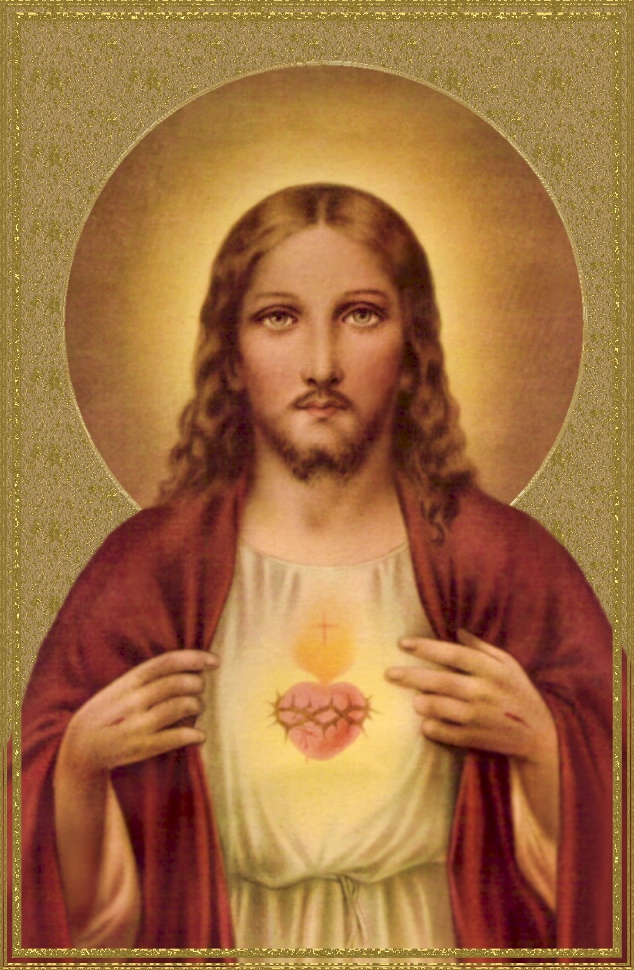
 Reparation to the Sacred Heart Fr. Raoul Plus, S. J.  Section III: The Practice of Reparation 1. The Spirit of Reparation REPARATION, before being a practice or a collection of practices, is first of all a spirit. Perhaps we do no more than is strictly required of us: but if we do it to compensate for the love which is withheld from God, we are making reparation. Take a poor working-woman; she has no leisure to devote to any exercises other than her ordinary work: her errands, her work in the factory, her hurried meals, her daily toil, all this she offers to console our Lord for the injuries that He received and still receives. Such a woman is making reparation. Conversely, one may perform many exercises of piety, but if they are not done with the intention of compensating for the love which men refuse to God, they are not works of reparation. The intention makes the action what it is, an act of reparation. I do not say that this intention must always be explicit; but it must be there at least implicitly. L'Abb é Buathier, in his excellent book Le Sacrifice, has well described the secret of those who devote their lives to reparation: "In a generation of apathy we find souls whose only ambition is to be 'victims,' and who find their joy therein. As others have feasts of pleasure, so these have feasts of suffering, royal feasts hidden from the world, but none the less real and intimate. . . . What is their source? Do they come from Calvary or from Thabor? It would be difficult to say; their sobs are so like canticles; but surely they come from Jesus, for their sobs or their canticles have an accent all Divine." Whether in the life of the world or of the cloister, such souls enter fully into the spirit of the Redemption. They offer themselves with the Divine victim of Calvary to expiate the sins of the world. By their sacrifice "they know that they not only pay the debt of their own sins, but that they may also pay for others, multiply their own merits and bequeath the treasure to the Church; that by their own death they can give life to many souls and offer them to Jesus; they know all this, they wish it, they desire it; the offering of these souls ascends to Heaven and in the agony of death their sacrifice is consummated in a joy which is a foretaste of peace and the beginning of glory. For these, as for Jesus on the Cross, death is but the supreme act of love. Men may see nothing of this, but the Angels look on in wonder, and God grants the crown." In reality every Christian who truly understands his Christian privileges should devote himself to reparation. In this sense the Founder of the Adoration R éparatrice (Rue d'Ulm, Paris) said that she regarded the work as the perfection of Christianity rather than as a new organization. An adequate conception of Christianity includes reparation; reparation is nothing else than Christianity fully understood and practised. It must be admitted, of course, that since the inclination of souls may vary indefinitely, there will be some who will not specially stress this idea and may prefer to lay emphasis upon another aspect of Christianity. All such inclinations, provided they are sound and based on Catholic doctrine, must be respected. But because many of the members of Christ know nothing of their vocation as members of Christ, or of the part that our Lord invites them to take in reparation; because others, while suspecting or fully knowing their vocation, either from indifference or cowardice refuse to follow it, therefore God asks certain souls to devote themselves entirely to the life of sacrifice. Hence the amazing and wonderfully fruitful vocations to this life which we find both in the world and in the cloister. Huysmans writes of St Lydwine: "God revealed to her the part of 'victim' that she was to play, explaining to her the meaning of St. Paul's words: "to fill up those things that are wanting of the sufferings of Christ." He taught her certainly that the human race is governed by laws, by the law of solidarity in evil and the law of reversion in good, solidarity in Adam and reversion in our Lord. In other words, up to a certain point, every individual is responsible for the sins of others, and to a certain extent has to expiate the sins of others; and each is able, if God so pleases, to assign in a certain measure the merits which he possesses or acquires to those who have none, or do not wish to acquire any. These laws were made by the Almighty and He Himself was the first to apply them in the case of His Own Son. The Father consented that His Son should take upon Himself to pay the ransom of others; He willed that the merits and satisfactions which could be of no use to Him, since He was innocent and perfect, should be of service to evil-doers, to all the sinners whom He had come to redeem; He willed that He should be the first example of mystical substitution, whereby He Who owes nothing takes the place of him who owes all; and Jesus in His turn wills that certain souls should be His successors and inherit His sacrifice. "Our Saviour can no longer suffer in Himself; His task of redemption was completed with the shedding of His Blood, His sufferings finished with His death. If He wishes to suffer still, He can do so only in His Church, in the members of His Mystical Body. "These souls devoted to reparation, who re-enact the horrors of Calvary, who take the place of Jesus nailed to the Cross, are in a sense counterparts of the Son; His face, streaming with Blood, is reflected in them as in a mirror; they enable Christ to suffer still for us; they fulfill that desire which survived His death, for His desire to suffer is infinite as is His love for men. . . . Were it not for these souls who, like their God, allow themselves to be punished for crimes of which they are innocent, the world would be like Holland without its dykes; it would be swallowed up in a sea of sin as the Netherlands would be overrun by the waves of the deep." We cannot but quote this text from an author who has written excellently on the subject of reparation: "One who devotes himself to reparation is thoughtful enough to realize the evil there is in the world, sensitive enough to suffer constantly at the thought of it, and generous enough to want to expiate it by the sacrifice of himself. At the feet of Jesus Christ he has contemplated Him on the Cross and seeing the Blood that flowed from it, has said to himself that between God and the human race there is a great and mysterious conflict; on God's side a love without limits, a love which led Him ardently to desire man's salvation and man's happiness; on man's side ingratitude, blindness, revolt. And so instinctively he has turned to Jesus and to His brethren, offering to the one a tender compassion, and to the other, for what it is worth, the help of his prayers and his sacrifices." (Chan. Leroux de Bretagne: La vie r éparatrice, p. 212.) In a play by E. Augier there are two brothers, Bernard and Leopold, one of whom, Leopold, does not know his relationship to the other. Bernard renders many services to his brother Leopold, and subsequently the latter, as the result of a misunderstanding, strikes his benefactor. Thereupon Bernard tells Leopold that he is his brother, to the confusion of the latter. Then Bernard opens his arms, presents his cheek to his brother with the words: "Cancel the blow." The application is easy. Someone has remained for a long time in ignorance of the bond of brotherhood that unites him to Jesus Christ and, without perhaps offending his Divine Master, has given little heed to making up by an excess of love for the deficiencies of tepid Christians, for the grave sins of sinners. One day our Lord manifests Himself -----on the occasion of some feast, a retreat, a sermon, during spiritual reading or fervent prayer. Until that moment he did not understand. Now he understands that our Lord is showing him each thorn of His crown and is asking him to offer in compensation a loving sacrifice; that He is showing him His pierced hands, as if asking for the priceless alms of His reparation; that He is asking him to count the drops of Blood that He shed during His agony and His scourging, and to offer in return the sweat of his works of reparation every day; he understands above all that the most cruel wounds of the Saviour have been within, and that it is by the gift of hearts that the agony of His Heart is solaced. "See," He says, "the sins of that soul consecrated to Me, the culpable neglect of that other, the tepidity of that third . . . Will you not make compensation? See the great sin of omission of secularized institutions. Children are being snatched from Me; adults are being corrupted. Will,you not make compensation? "Today, as throughout the course of history, there are two cities, the city of good and the city of evil; and sometimes the children of darkness show greater zeal than the children of light. Who will undertake to check the dark powers of evil, and make reparation for the sins committed against Me? Will you? "They are striving to turn the working-classes against Me. Poor wretches, led astray by shameless men. This is an especial sorrow to Me, for I have a special love for those whom life treats hardly; and most of them do not know Me, do not love me. Will you make compensation? "And in the bosom of families what a number of sins are committed! If the frontages of all the houses were suddenly to fall, what immorality we should see: fornication, adultery, onanism, impurity of all kinds, base acts of revenge, jealousies, injustices, sometimes the lack of the most elementary charity. . . .T o compensate for all this I need souls devoted to reparation. Will you be one of them?" And the call of the Master does not remain unheard. Many priests and religious are gravely negligent; there will be souls to make up for the deficiencies in the priestly and religious life. There are lamentable sins of omission in official education and in national institutions. There will be souls to make reparation, some of them arising in these very institutions themselves. Social relations are the occasion of many sins: injustice and uncharitable treatment in the higher classes, and in the lower, jealousy, hatred and scorn for obedience and self-denial. But there will be souls to make reparation for the sins committed in social relations. Even in the sanctuary of the family many sins are committed; but in compensation there will be souls to expiate them. But a natural objection may present itself to the mind of more than one of my readers: "Who am I to make compensation for the sins of others; before thinking of theirs would it not be better to pay attention to my own?" Consequently a great spiritual writer says: "To offer oneself in this way one must be very pure, one must have made satisfaction for one's own sins before thinking of expiating those of others." 1 That illusions in this matter are easy, that the imagination may outstrip the efforts of virtue, is but too true. Certain it is that here a wise humility is necessary, and that before attempting works of counsel we must first make sure of the essentials, according to the advice: "Physician, heal thyself." Nevertheless we must not exaggerate the conditions necessary for making reparation for others. If all the souls called to this work waited until they could say that they have no more satisfaction to offer for their own sins, how many such souls should we find? Above all it must be remembered that many souls, while they are faithful in observing God's law, are yet held back by the thought of their unworthiness and, much to their detriment, find their efforts stifled. To these souls, whose thoughts are constantly turned upon themselves, who seem incapable of what we may call a "centrifugal" spirituality, we should not venture to propose as a rule the proposition cited above. Rather we would say to them! "Forget your own failings; do not think of them any more, leave them to God's mercy. Think only of others, devote yourself to expiating the sins of others. And God, seeing your efforts of love and true charity, will see that you have enough to compensate for your own shortcomings. There is no illusion in this: it is merely a means for your spiritual development." Thank you Anne, for providing this image of the Sacred Heart. Image of the Sacred Heart generously sent to Catholic Tradition by Anne P. It is one of the loveliest we have ever seen. We added the gold background and trim to the halo. Thank you ever so much, dear Anne. 1. Garrigou-Lagrange: Vie Spirituelle, f év. 1928, p. 516.   HOME----------HOLY HEARTS DIRECTORY www.catholictradition.org/Two-Hearts/reparation5.htm |