
 "I Have Lost the Faith"  Taken from Magnificat magazine, March, 2006. "Ask and it shall be given you: seek and you shall find: knock and it shall be opened to you." ---St. Matthew 7:7 Today it is not unusual to hear people who have been Baptized declare, and unfortunately all too often almost triumphantly, without a trace of sadness, "I don't believe in God anymore, I have lost the Faith." Is this true? Shouldn't they say instead, except for a few rare exceptions, "I have lost the will to believe"? The story of the loss of faith, from one soul to the next, bears a sad resemblance. First of all, ignorance in religious matters, even among people well educated in other realms, is one of the primary causes of unbelief. Religious instruction, if and when it exists, is generally limited to childhood, and it disappears during adolescence and adulthood. Nothing could be more unreasonable than this, since the primary purpose of our life is to know God in order to love Him and serve Him.  Saint
Pius X said, "if we cannot expect a harvest from soil that has received
no seed, how can we hope for generations with good morals if they have
not been instructed in Christian Doctrine in due time? ... If the Faith
has languished in our day, to the point that it is almost dying among
many, it is because the duty of religious instruction is accomplished
too negligently or completely omitted ... Certainly, all of us who have
been Baptized in Jesus Christ have infused Faith within us: but that
Divine seed does not rise and does not grow strong branches if
it is abandoned to itself and reduced to acting only out of a sort of
innate virtue ... The teaching of the Church is needed so that this
Faith may be nourished, grow and bear fruit. It is in this sense that
the Apostle said, 'Faith comes by
preaching, and preaching comes by the Word of Christ.' " [St.
Paul, Romans 10:17] Saint
Pius X said, "if we cannot expect a harvest from soil that has received
no seed, how can we hope for generations with good morals if they have
not been instructed in Christian Doctrine in due time? ... If the Faith
has languished in our day, to the point that it is almost dying among
many, it is because the duty of religious instruction is accomplished
too negligently or completely omitted ... Certainly, all of us who have
been Baptized in Jesus Christ have infused Faith within us: but that
Divine seed does not rise and does not grow strong branches if
it is abandoned to itself and reduced to acting only out of a sort of
innate virtue ... The teaching of the Church is needed so that this
Faith may be nourished, grow and bear fruit. It is in this sense that
the Apostle said, 'Faith comes by
preaching, and preaching comes by the Word of Christ.' " [St.
Paul, Romans 10:17]It is obvious that one cannot be convinced of what he does not know. Nevertheless, the intelligence is not the only faculty that plays a part in the act of faith: the will plays a primary role. Very often a person does not believe because he lacks humility, or because he is too strongly attached to certain enjoyments. Father Devivier writes in Cours d'apologétique chrétienne, "Especially among young people who have had the good fortune of being raised with religious ideas, the weakening or loss of faith is ordinarily due to dissolute morals." The great preacher and author Bossuet writes as follows: "What is the origin of this troop of libertines that we see rising so boldly, in the bosom of Christendom, against the truths of Christianity? They are not irritated because someone proposes that they believe in unbelievable mysteries; they have never taken the trouble to examine them seriously. That God engenders in eternity, that the Son is equal to the Father, that the depths of the Word made flesh are as profound as one would wish: that it not what torments them. They are ready to believe whatever you like, as long as they are not pressed regarding whatever they like ... In a word, let god be and do all that He wishes in Heaven as long as He lets them satisfy their passions on earth as much as they wish. But Jesus Christ came to make them hate the World, and that is what is unbearable for them, that is what creates revolts, that is why they crucify Him." [1] 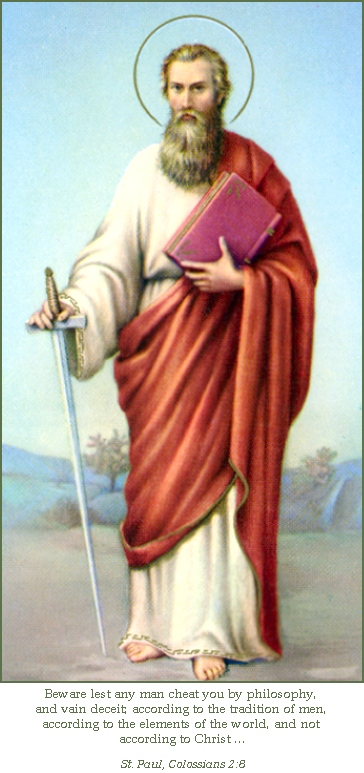 In
short, we would not have much trouble accepting a lenient God Who would
not bother us at all in our pleasures and comforts. This is explained
by Bossuet: In
short, we would not have much trouble accepting a lenient God Who would
not bother us at all in our pleasures and comforts. This is explained
by Bossuet:"Our disordered passions, our attachments to our senses, and our invincible pride are the cause of unbelief. We would prefer to risk everything rather than restrain ourselves. We would prefer to wallow in our ignorance rather than admit it. We would prefer to satisfy a vain curiosity and cultivate our in intractable mind the freedom to think whatever we like rather than bow beneath the yoke of Divine authority. "That is why there are so many unbelievers, and God permits it thus for the instruction of His children. Were it not for the blind, for the unbelievers who remain in the very bosom of Christendom, we would not know the profound corruption of our nature well enough, nor the abyss from which Jesus Christ has drawn us. If His holy truth were not contradicted, we would not see the wonder that has caused it to endure amid so many contradictions, and we would eventually forget that we are saved by grace." [2] These words of the great bishop remind us, among others, of the testimony of the poet and member of the French Academy, François Coppée: "I was raised a Christian," he says, "and after my First Communion I fulfilled my religious duties with naive fervor for several years. I can frankly say that is was the crisis of adolescence and the shame of certain admissions that caused me to abandon my piety. "If they were sincere, many men would agree that the first thing that made them leave religion was the severe rule it imposes upon everyone from the standpoint of the senses. And they would agree that it was only later that they asked reason and science for the metaphysical arguments that would give them leave to restrain themselves no longer. For me at least, that is how it was. I stopped practicing religion due to wrongful shame, and all the evil stemmed from that first sin against humility, which decidedly appears to me as the most necessary of the virtues. "Once that step had been taken, I would not fail, as time went on, to read many books, hear many words and see many examples destined to convince me that nothing could be more legitimate for a man than to follow his pride and his sensuality. And soon I became virtually indifferent to any religious preoccupation. As anyone can see, my case is a very banal one: it was the vulgar desertion of a soldier weary of discipline. I did not detest the flag under which I served, but I had run away from it and was forgetting it ... that is all." [3] We willingly accept a truth, a beautiful doctrine, inasmuch and as long as that truth does not condemn us. Here is what Bossuet says on the subject in his Discours sur la haine contre la vérité (Discourse on Hatred of the Truth): "When truth does nothing but display itself in beautiful and adorable maxims, a heart would have to be very coarse to refuse this Divine beauty its affection. But when the same beauty that delighted our eyes sheds full light upon our imperfections and faults, and the truth, not satisfied with showing us what it is, comes and shows us what we are, then it is as if it lost all its beauty by revealing our ugliness to us, and at once we begin hating it, and that beautiful mirror displeases us because it is all too faithful ... "For every one that doth evil hateth, and cometh not to the light, that his works may not be reproved, [St. John 3:20] says the Son of God. All those who violate the law of God hate His holy truth ... Destroying it within themselves, and not wanting to give it any place in their life, they would like to be able to destroy it wherever it is found, and chiefly in its origin (God). They are irritated against the laws, they become angry because the things they love in a disordered manner are severely forbidden them. Feeling themselves too forcibly pressed by the truth, they wish it did not exist. "For what does an evildoer desire more than impunity in his crime? And to have this impunity, would he not wish to be able to abolish the law that condemns him, the truth that convicts him, and the power that weighs upon him? And is not all of that God Himself? ... That is why the Psalmist said, The fool says in his heart, 'There is no God.' [Psalm 52:1] He wishes there were none, and as Saint Augustine says, 'Those who do not want to be just wish that there were neither justice nor truth in the world to condemn criminals.' "What did the Divine Saviour do to the world? He strongly censured the proud sinners, He unmasked the hypocrites, He confounded the scandalous, He was a torch that revealed to every man's eyes all the disgrace of his life. What was the outcome of this? You know what it was, and Jesus Christ said it: The world hates Me because I bear witness concerning it, that its works are evil. [St. John 7:7] And elsewhere, speaking to the Jews, He says, That is why you seek to kill Me, because My word has no place in you, [St. John 8:37] and because My truth is a burden to you." [4]  Some people may object that their reasons for not believing in God are different from those given above. Whatever those reasons might be, we cannot ignore the fact that God does not hide from those who seek Him in all sincerity. In his Sermon for the religious profession of Madame de la Vallière, who became Sister Louise de la Miséricorde, Bossuet says, "Whoever seeks God in good faith never fails to find Him. If you can say, following the example of so many holy penitents who were men like you, 'O Lord, I want You,' then God is yours. For His goodness never lets Him refuse Himself to a heart that desires Him; neither can any power, however imposing, steal Him from the one who possesses Him; nor is He a fickle friend that time can change." Uprightness of intention, sincere seeking after God and humble prayer: these are the conditions for finding the faith again. Although the arguments of apologetics are very useful, they alone do not suffice. As Msgr. Dupanloup said, "Between you and religion, it is less a matter of truth than a matter of virtue." Whatever anyone may say, the essential point is to truly want to put one's life in harmony with the requirements of the Gospel. Most of the time, the obstacle to faith is only one's refusal of the change that must be carried out: abandoning a bad habit, breaking off a sinful affair, accepting disapproval in order to conform oneself to God's wishes, compromising a brilliant career to be honest at all costs, etc. Faced with these necessary renouncements, nature balks and looks for a thousand reasons to cast doubt upon the truth that imposes such changes. And that is why so many souls remain unbelieving ... But if they would accept the yoke of the Lord, what happiness they would find, already in this world! My yoke is sweet and my burden light, [St. Matthew 11:30] says Jesus. This is a great truth, but we can only be convinced of certain things by experiencing them. Although man has his part to play, he will never get anywhere without the help of God. One day when Jesus was questioning His Apostles and asked them what they thought of Him, Saint Peter exclaimed, Thou art the Christ, the Son of the living God. And what did Jesus say to him in reply? Neither more nor less than this: It is not by yourself, not by the reasoning of your mind of flesh and blood, that you were capable of reaching this conclusion. It is My Father in Heaven who has given you faith in Me. [Cf. St. Matthew 16:16-17] Ask and you shall receive, says Our Lord Jesus Christ, seek and you shall find, knock and it shall opened to you. [St. Matthew 7:7]   Composition: D.D.M. 1. Sermon by Bossuet: "Judgment of Jesus Christ against the world." 2. Bossuet, Discours sur l'Histoire universelle, Part II. 3. F. Coppée, cited in Paroles et Traits historiques les plus remarquables, by Abbé J. Berthier, M.S. [La Salette, 1898] 4. Bossuet, "Discours sur la haine contre la vérité."  E-Mail E-Mail HOME-----------------------TRADITION www.catholictradition.org/Tradition/faith5.htm |