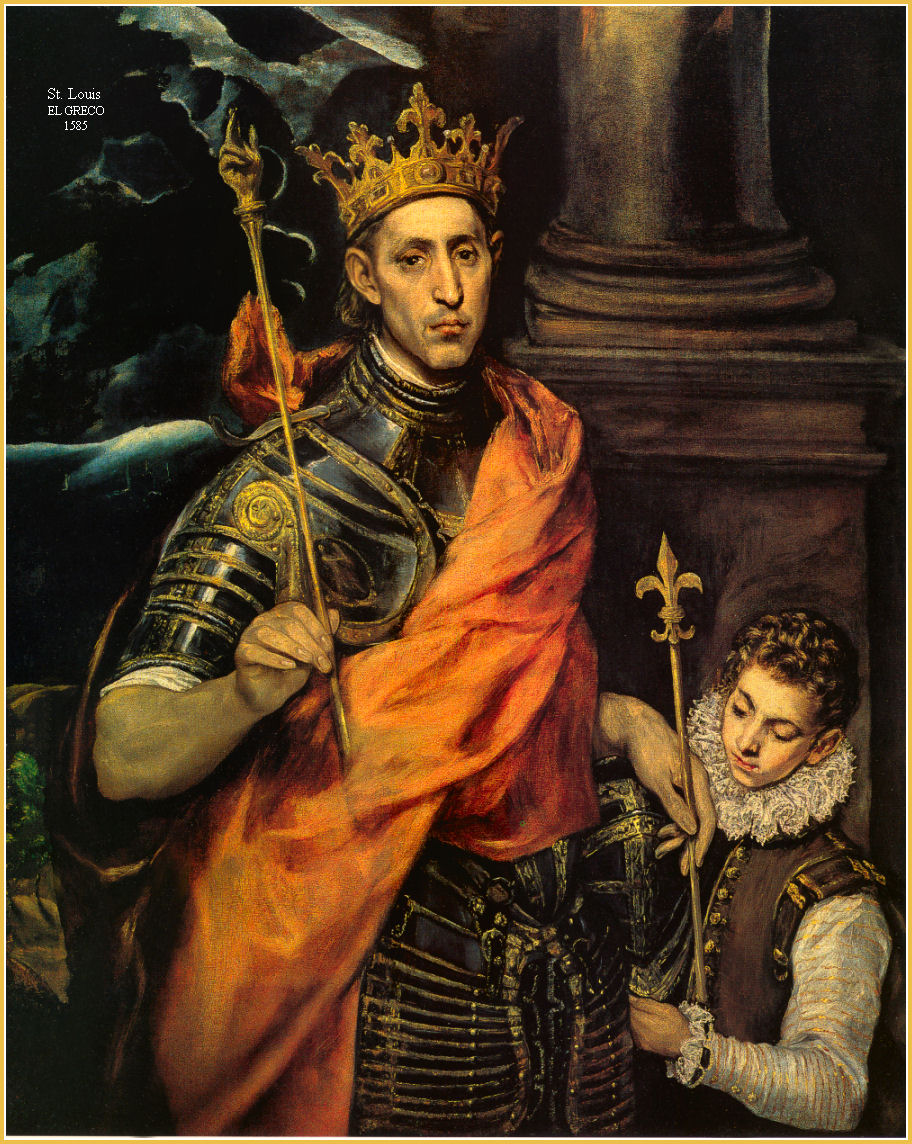
St. Louis IX, King August 25 1214-70 Born at Poissy, France, on April 25, the son of King Louis VIII and Blanche of Castile, he was raised in a religious atmosphere by his mother. His father died in 1226 when he was twelve, and Blanche became regent. She defended his throne against Thibaut of Champagne and other ambitious nobles by alliances, and when necessary, by war. He married Margaret, daughter of Count Raymund Berenger of Provence, in 1234, and the couple had eleven children. On reaching his majority in the same year, he assumed the reins of ruler, though Blanche was his adviser until her death. He put down revolts in southern France, 1242-43, defeated King Henry III of England at Taillebourg in 1242, securing suzerainty over Guienne by his victory, and in the same year forced Poitou to submit to him; in 1243 he compelled Raymond VII of Toulouse to submit to him. He went on crusade in 1248 and captured Damietta in 1249 but suffered a disastrous defeat at the hands of the Saracens at EI Mansura in 1250 and was taken prisoner. After he ransomed himself and his men, he went to the Holy Land and remained there until 1254, when Blanche died and he returned to France. He imposed peace on Flanders in 1256, and ceded Limoges, Cahors, and Perigueux to King Henry III of England in return for Henry's renunciation of any claims he had to Normandy, Anjou, Maine, Touraine, and Poitou with the Treaty of Paris ratified in 1259. He ended Aragon's claims to Provence and Languedoc by yielding French claims to Roussillon and Barcelona in the Treaty of Corbeil in 1258. He set forth on a new crusade in 1270 but contracted typhoid soon after landing in Tunisia and died there near Tunis on August 25. Noted for his justice, ability, charity [he dressed the wounds of the poor and sometimes fed over a thousand a day], and personal piety, Louis founded numerous religious and educational institutions (he rebuilt the Sainte-Chapelle in Paris, 1245-48, to house the Crown of Thoms given him by Emperor Baldwin II in 1239, and supported the founding of the Sorbonne in 1257) and forbade war among the feudal lords. He protected vassals from oppression by their lords and made the lords live up to their obligations. A man of his word, he was often sought out as an arbitrator and settled disputes about succession in Flanders, Navarre, and Hainaut and between King Henry III and his barons in 1263. Under his reign, France enjoyed unprecedented prosperity and peace as he followed a policy of peaceful coexistence with his European neighbors improved the tax system, simplified administration, extended the appellate jurisdiction of the crown to all cases, and encouraged the use of Roman law. Gothic architecture flowered during his regime and he built the first French navy. He was one of the greatest of all French Kings and embodied the highest ideals of medieval kingship in the forty-four years of his rule. He was canonized in 1297 by Pope Boniface VII. LITANY OF KING LOUIS     HOME---------------PRAYERS AND DEVOTIONS-----------------LITANIES www.catholictradition.org/Saints/saints8-18.htm |