 AND THE SHRINES On June 23, 1867, the image of Our Mother of Perpetual Help was crowned by the Dean of the Vatican Chapter in a solemn and official recognition of the Marian icon that had been rescued from oblivion. Since then, devotion to the Mother of Perpetual Help has grown. One factor that contributed to this phenomenal growth was that innumerable copies of the icon were distributed from Rome throughout the world. On April 21, 1866, the Redemptorist Superior General gave one of the first copies to Pope Pius XI, which is now preserved in the chapel of the Redemptorists' General Government in Rome. Another decisive factor in the spread of the devotion was that the Redemptorists made the icon a missionary and Marian image for the entire Congregation, frequently distributed even today as part of a parish mission preached by the Order. On May 23, 1871, the Pious Union of Our Lady of Perpetual Help was established in the Church of St. Alphonsus in Rome. In 1876, the Archconfraternity of Our Lady of Perpetual Help and St. Alphonsus Liguori was formed. On December 25, 1878, in Santiago, Chile, the Perpetual Intercession was inaugurated and in 1928 the official beginning of the the Perpetual Novena took place in the Church of St. Alphonsus, St. Louis, MS, the actual although unofficial beginning was in 1922. 1. Why the Redemptorists? Why was this icon given to the Redemptorists? There is no answer, as some things are only understood by God. Pope Pius IX held the Order in high esteem. On one occasion at the tomb of St. Alphonsus, the Pontiff took off his Papal ring to exchange it for the Bishop's ring the saint wore. The Order was founded in 1732 to evangelize the poor and most abandoned. In the middle of the 19th century they were about to begin a growth period that would carry them throughout the world. The Pope recognized that they would have the opportunity to make the icon known and proclaim., as had their founder. the glories of Mary. Beyond all human reasons, there was God's reason. Could it be that he wanted a connection between the icon whose message is Redemption and the Congregation whose purpose is preaching this message?  2. The Church of St.
Alphonsus
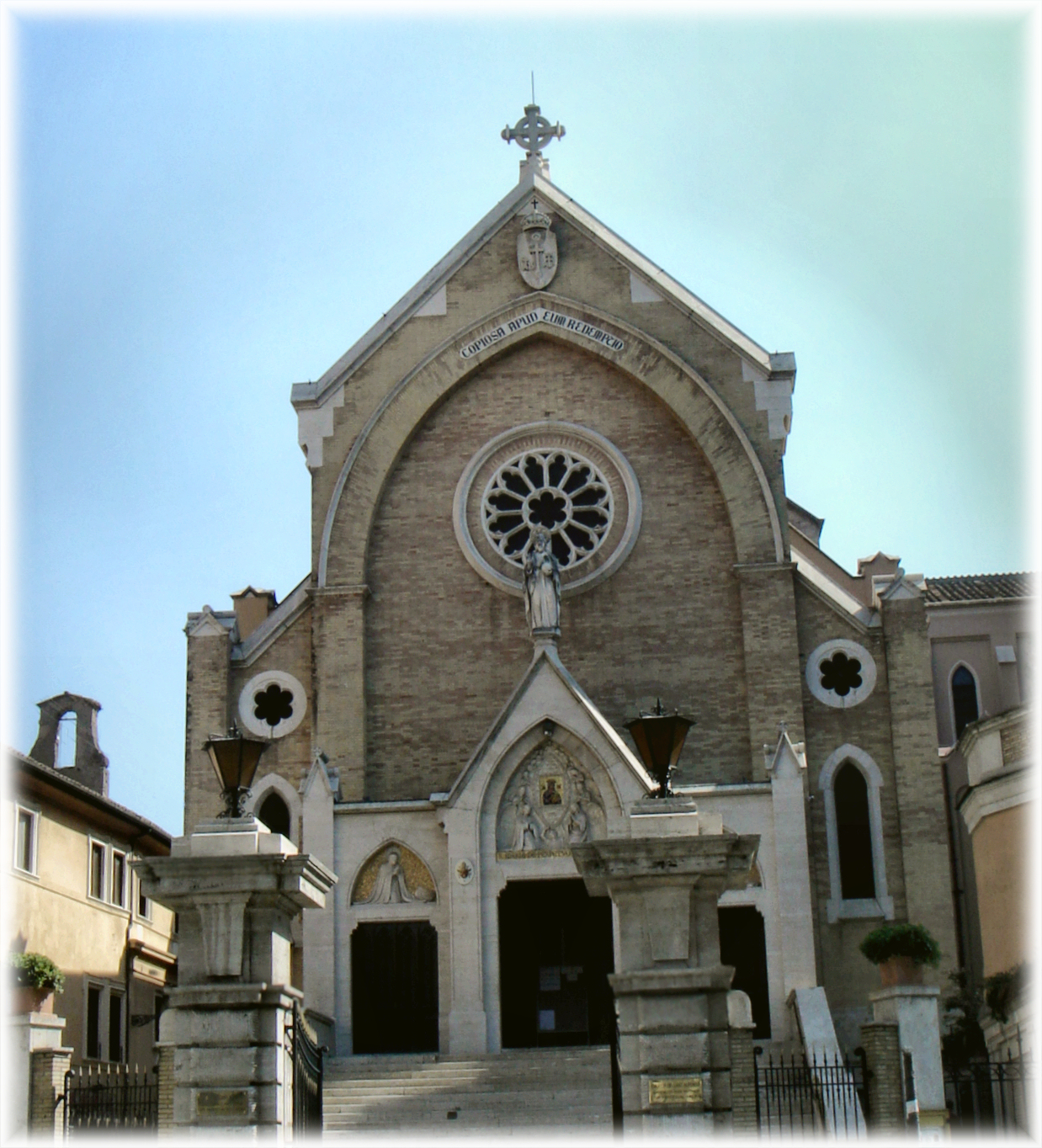
in Rome 2. The Church of St.
Alphonsus
in Rome The church that houses the original icon is on the Via Merulana, near the Basilica of St. Mary major. When the Italian Army of Unification conquered Rome in 1870, the Redemptorist house and church faced the threat of expropriation. But once again, Our Mother of Perpetual Help providentially intervened on her own behalf, this time through a woman from the United States. This devotee of Mary learned that the wife of the American ambassador was coming to Rome. So she implored her to visit the Sanctuary of Perpetual Help, which she did, taking an interest in the Redemptorists. Thus, in 1878, a favorable verdict guaranteed them definitive title to both the house and church. Among the many illustrious pilgrims of those first years were Mother Antonia de Oveido, foundress of the Oblates of the Most holy Redeemer, who donated the sanctuary lamps; and Charles de Foucauld, who had come to Rome to renew his consecration to the Virgin of Perpetual Help. Today the Novena is celebrated every Wednesday for Polish pilgrims and on Thursdays in English for the Filipino residents of Rome. 3. The Basilica of Perpetual Help in Boston, MA In February of 1870, The Redemptorists began construction on the first church dedicated to Our Lady of Perpetual Help, a wooden structure, which soon became too small to accommodate the growing number of Our Lady's devotees. A new church was built, the present Basilica, consecrated in 1878. This church has three naves in perfect proportion, two impressive spires and 12 enormous bells. The main altar holds the Perpetual Help image. 4. South American Shrines One of the first places in South America where the icon arrived was in Surinam. Bl. Peter Donders enthroned her image in the wooden chapel of the local leper colony. The Redemptorists brought the devotion to Ecuador, from which it spread to Chile, peru and Colombia. In Santiago, Chile, an association of devotees of the Virgin of Perpetual Help, called Perpetual Intercession, was founded in 1879. Within fifteen years it had 1,650 members. After a time a larger church was needed and thus rose the beautiful Goth church under the supervision of three Redemptorist brothers. It took 15 years to complete the edifice. In 1926 it was declared a "Minor Basilica." Basilicas are churches that have been conferred with an honorary title. They fall into two classes: major and minor. There are only four major basilicas in the world, all in Rome. It is the prerogative of the Pope to grant the minor title to other churches, which gives the clergy serving there precedence of rank. The Redemptorist presence in Brazil is recent, dating from 1960. So many people began to gather for the Novena that they overflowed into the streets, within 6 years. Then the present sanctuary in Curitiba was built. Every Wednesday from early in the morning until 9 PM at night 11 Novenas are prayed. About 18, 00 attend these every week. The devotion is in fact thriving in Brazil, with even larger participation in Belem near the Amazon delta, with at least 20, 000 each Wednesday. 5. Other World-Wide Shrines The devotion has been spread in the Philippines since 1906 by Redemptorist missionaries. During World War II Japanese troops took over the Redemptorist house in Manila, dispersing the religious community. The Fathers were able to save the icon by concealing it with friends. At the end of the war, the Fathers returned, but to their dismay they discovered that their friends' house had been looted and burned; the image of the Virgin was nowhere to be found. After much praying and searching, they found it in an Army warehouse. Our Lady's icon was returned to her proper place for public veneration. The Perpetual Novena was first celebrated in 1948. Five years later, construction was begun on a new church to provide room for the crowds, and was finished in 1958. From that time the church continues to hold some 11,000 persons and never closes its doors, literally open day and night because so many come at all hours to keep Our Lady company. As many as 120,000 have come for the Wednesday Novena. From the earliest of Christian times, ireland has been known as the cradle of missionaries. The Augustinians who guarded the icon of Perpetual help in St. Matthew's Church in Rome, were irish. In more recent times, the Redemptorists have crisscrossed the breath of Ireland giving parish missions, recognized for their Marian devotions. The Sanctuary of Perpetual help in Limerick sees more than 50,000 faithful participants daily for an annual Novena. In Belfast, the Church of the Most Holy Redeemer, began the Novena in 1943. to this day an annual Solemn Novena to perpetual help is held and thousands come daily. What is particularly notable that in this city of religious conflict between Protestants and Catholics, Protestant pastors and some parishioners attend the Novena. The icon is well known and venerated in Eastern Europe" Poland, the Czech republic, Slovakia, and parts of the Soviet Union. Perhaps the most famous sanctuary is the located in Krakow, Poland. The devotion started there in 1903, when the Redemptorists enthroned a copy of the icon blessed by Pope Leo XIII. Pope John Paul II has prayed there often before ascending to the papal chair, making a historic visit back there in 1991. In Singapore the Church of St. Alphonsus, known as the "Novena Church," can be reached by taking the subway to the "Novena" station. Every saturday more than 20,000 gather for celebrations of the Perpetual Novena. Interestingly, Singapore, a Buddhist country, is host to Our Lady and many of the devotees are not Catholic.  Haiti not only has many devotees of the icon , it itself, as a country, is actually consecrated to Our Lady of Perpetual Help. In 1881 Haiti was afflicted with a horrible epidemic of smallpox, particularly in the capital of Port-au-Prince. The doctors saw no solution other than intense storms to cleanse the atmosphere. But that time of the year was known as the "dry season." One woman had brought a copy of the icon from france and offered it to the rector of the Cathedral of Port-au-Prince, hoping that invoking the Holy Virgin would alleviate the plague. On February 5, 1882, a solemn procession was held during which the image was carried to a small chapel overlooking the city. The Novena began. Five days later, contrary to all weather predictions, several cloudbursts occurred. From that moment the epidemic began to diminish and no new cases were reported. The people of Haiti had no doubt that it was Our Lady's intercession that had saved them. Since then she has been called "The Virgin of the Miracle." The picture of her is found in almost every home. Even the civil government officially place the nation under her protection. In many parts of Latin America copies of the Icon arrived before the Redemptorists, but the spread of the devotion is due to them because of the many missions the Order has preached. In Mexico the first copy of the icon appeared in the Cathedral of Morelia, Michoacan. In Mexico City the first altar dedicated to our lady of Perpetual help was in the Church of San Diego, and was subsequently moved to the church of the Holy cross. There are several churches throughout Mexico dedicated to her. The profound faith of the Mexican people for the Virgin of Guadalupe is well known. But devotion to Our Lady of Perpetual help is not seen as competition to the Virgin of Guadalupe, but rather the faithful, who call Our Lady of Perpetual help, :the Dark Virgin," the Mother of Jesus and the Mother of the faithful is always ready to help her children. 6. A Universal Devotion During several centuries the Icon of Perpetual Help was known only in Rome. But since 1866 her presence and the devotion have spread world wide, not only because of the favors granted by Our Lady of Perpetual help, but also because of the faithful preaching of the Redemptorist Missionaries. A glance of directories of dioceses all over is sufficient to see that Our Lady's icon is venerated from Vancouver, Canada to Mumbai, Bombay, India. In the Pontifical Directory, there is a listing of six religious congregations of Sisters with the name of "our Lady of Good Help," and three with the title, "Our lady of Perpetual help." And this does not include those within the Melkite Orthodox rite [not in union with Rome]. In various countries there are hospitals and other social institutions dedicated to her, as well as many Catholic magazines that bear the name of Perpetual help in the United States, Spain, Mexico, Italy, etc.
 E-Mail E-Mail HOME------------------MARY'S INDEX------------------OUR LADY OF CZESTOCHOWA
www.catholictradition.org/Mary/olph3.htm |
