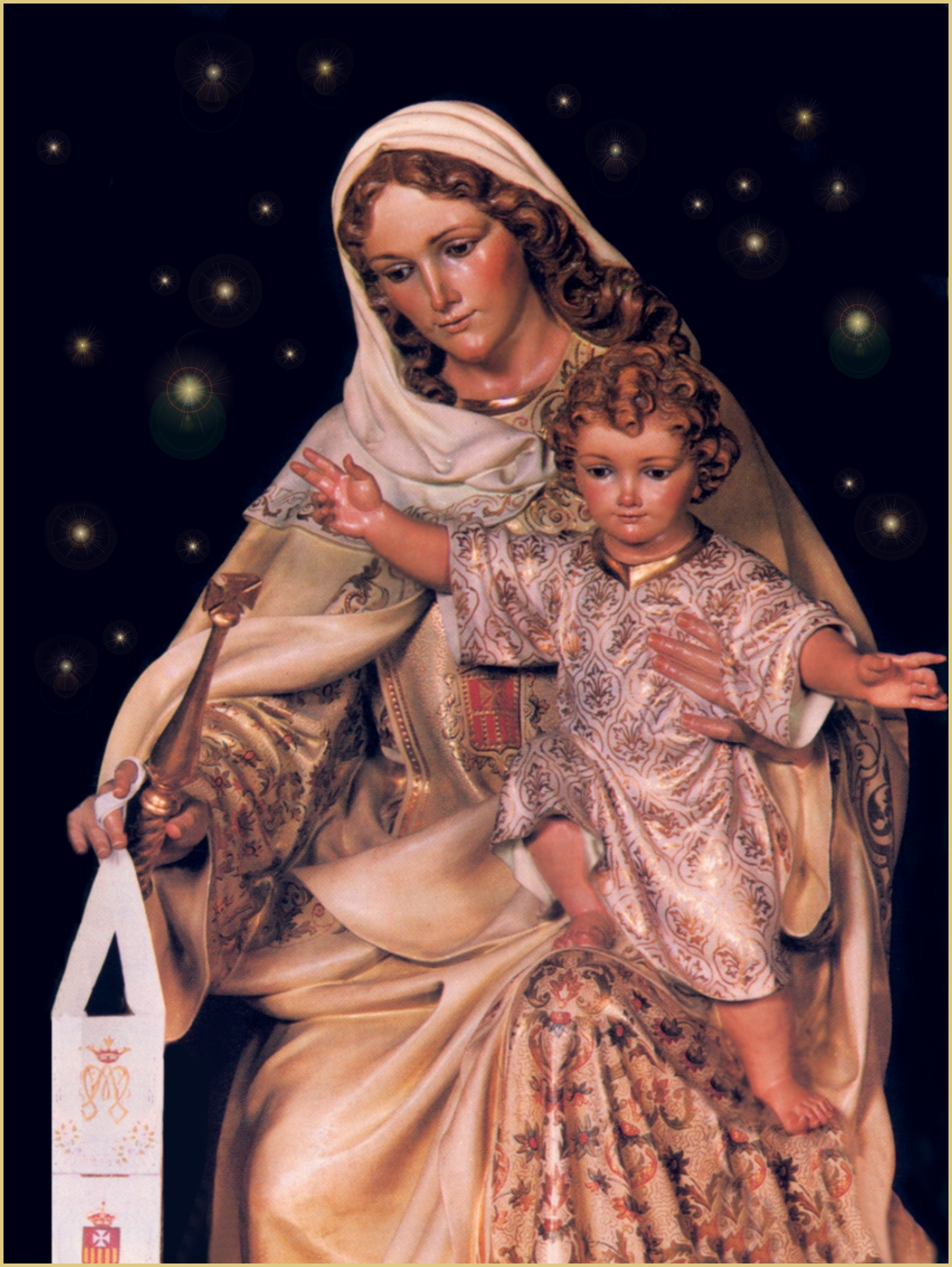
  Our Lady of Ransom, September 24 Also Known as the Feast of Our Lady of Mercy From THE LITURGICAL YEAR, Dom Gueranger THE Office of the time gives us, at the close of September, the Books of Judith and Esther. These heroic women were figures of Mary, whose birthday is the honor of this month, and who comes at once to bring assistance to the world. 'Adonai, Lord God, great and admirable, Who hast wrought salvation by the hand of a woman:' the Church thus introduces the history of the heroine, who delivered Bethulia by the sword, whereas Mardochai's niece rescued her people from death by her winsomeness and her intercession. The Queen of Heaven, in her peerless perfection, outshines them both, in gentleness, in valor, and in beauty. Today's feast is a memorial of the strength she puts forth for the deliverance of her people. Finding their power crushed in Spain, and in the east checked by the Latin kingdom of Jerusalem, the Saracens, in the twelfth century, became wholesale pirates, and scoured the seas to obtain slaves for the African markets. We shudder to think of the numberless victims, of every age, sex, and condition, suddenly carried off from the coasts of Christian lands, or captured on the high seas, and condemned to the disgrace of the harem or the miseries of the bagnio. Here, nevertheless, in many an obscure prison, were enacted scenes of heroism worthy to compare with those witnessed in the early persecutions; here was a new field for Christian charity; new horizons opened out for heroic self-devotion. Is not the spiritual good thence arising a sufficient reason for the permission of temporal ills? Without this permission, Heaven would have for ever lacked a portion of its beauty. When, in 1696, Innocent XII extended this feast to the whole Church, he afforded the world an opportunity of expressing its gratitude by a testimony as universal as the benefit received. Differing from the Order of holy Trinity, which had been already twenty years in existence, the Order of Mercy was founded as in were in the very face of the Moors; and hence it originally numbered more knights than clerics among its members. It was called the royal, military, and religious Order of our Lady of Mercy for the ransom of captives. The clerics were charged with the celebration of the Divine Office in the commandaries; the knights guarded the coasts, and undertook the perilous enterprise of ransoming Christian captives. St. Peter Nolasco was the first Commander or Grand Master of the Order; when his relics were discovered, he was found armed with sword and cuirass. . . . READ MORE HERE: EXTERNAL LINK WITH ANOTHER IMAGE OF OUR LADY OF MERCY At the time when the Saracen yoke oppressed the larger and more fertile part of Spain, and great numbers of the faithful were detained in cruel servitude, at the great risk of denying the Christian faith and losing their eternal salvation, the most blessed Queen of Heaven graciously came to remedy all these great evils, and showed her exceeding charity in redeeming her children. She appeared with beaming countenance to Peter Nolasco, a man conspicuous for wealth and piety, who in his holy meditations was ever striving to devise some means of helping the innumerable Christians living in misery as captives of the Moors. She told him it would be very pleasing to her and her only-begotten Son, if a religious Order were instituted in her honor, whose members should devote themselves to delivering captives from Turkish tyranny. Animated by this heavenly vision, the man of God was inflamed with burning love, having but one desire at heart, viz.: that both he and the Order he was to found, might be devoted to the exercise of that highest charity, the laying down of life for one's friends and neighbors. That same night, the most holy Virgin appeared also to blessed Raymund of Penafort, and to James, king of Aragon, telling them of her wish to have the Order instituted, and exhorting them to lend their aid to so great an undertaking. Meanwhile Peter hastened to relate the whole matter to Raymund, who was his confessor; and finding it had been already revealed to him from Heaven, submitted humbly to his direction. King James next arrived, fully resolved to carry out the instructions he also had received from the blessed Virgin. Having therefore taken counsel together and being all of one mind, they set about instituting an Order in honor of the Virgin Mother, under the invocation of our Lady of Mercy for the ransom of captives. On the tenth of August, in the year of our Lord one thousand two hundred and eighteen, King James put into execution what the two holy men had planned. The members of the Order bound themselves by a fourth vow to remain, when necessary, as securities in the power of the pagans, in order to deliver Christians. The king granted them license to bear his royal arms upon their breast, and obtained from Gregory IX the confirmation of this religious institute distinguished by such eminent brotherly charity. God Himself gave increase to the work, through the Virgin Mother; so that the Order spread rapidly and prosperously over the whole world. It soon reckoned many holy men remarkable for their charity and piety who collected alms from Christ's faithful, to be spent in redeeming their brethren; and sometimes gave themselves up all ransom for many others. In order that due thanks might be rendered to God and His Virgin Mother for the benefit of such an institution, the Apostolic See allowed this special feast and Office to be celebrated and also granted innumerable other privileges to the Order. Blessed be thou, O Mary, the honor and the joy of thy people! On the day of thy glorious Assumption, thou didst take possession of thy queenly dignity for our sake; and the annals of the human race are a record of thy merciful interventions. The captives whose chains thou hast broken, and whom thou hast set free from the degrading yoke of the Saracens, may be reckoned by millions. We are still rejoicing in the recollection of thy dear birthday; and thy smile is sufficient to dry our tears and chase away the clouds of grief. And yet, what sorrows there are still upon the earth, where thou thyself didst drink such long draughts from the cup of suffering! Sorrows are sanctifying and beneficial to some but there are other and unprofitable grief, springing from social injustice: the drudgery of the factory, or the tyranny of the strong over the weak, may be worse than slavery in Algiers or Tunis. Thou alone, O Mary, canst break the inextricable chains, in which the cunning prince of darkness entangles the dupes he has deceived by the high- sounding names of equality and liberty. Show thyself a Queen, by coming to the rescue. The whole earth, the entire human race, cries out to thee, in the words of Mordechai: 'Speak to the King for us, and deliver us from death!'  The image of our Lady of Mercy is used with the kind permission of the Mercedarian Order, New York. It is copyrighted and you may not download it.  E-Mail E-Mail HOME-------------------------------------MARY'S INDEX www.catholictradition.org/Mary/mary3a.htm |