When Freedom and Love Were One:
The Annunciation
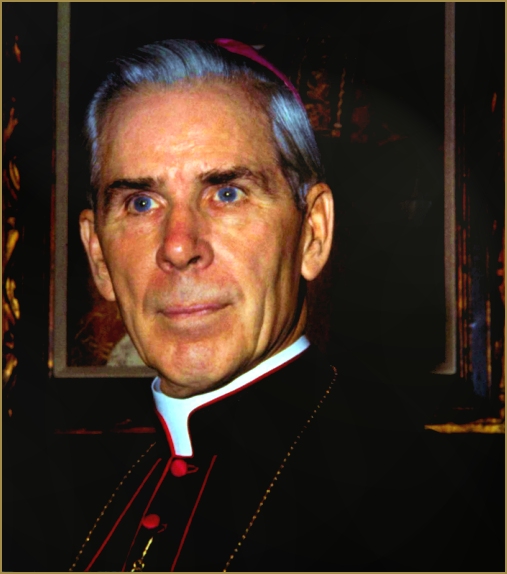
by Bishop Fulton J. Sheen
1952

TAKEN FROM THE WORLD'S FIRST LOVE
The modern age, which gives primacy to sex, justifies promiscuity and divorce on the grounds that love is by its nature free — which, indeed, it is. All love is free love, in a certain sense. To be devoid of love is of the essence of Hell. Scripture tells us: "Where the spirit of the Lord is, there is liberty" (2 Cor. 3:17). The ideal life is fulfilled — not in subjection to an absolute law but in the discriminating response of an educated affection.
The formula that love is free is right. The interpretation of this can often be wrong. Those husbands who leave one wife for another may justify their infidelity on the grounds that "one must be free to live his own life." No one is ever selfish or voluptuous without covering up his demands with a similar parade of ideals. Behind many contemporary affirmations of the freedom of love is a false rationalization, for although love involves freedom, not all freedom involves love. I cannot love unless I am free, but, because I am free, still I may not love as I please. A man can have freedom without love — for example, he who violates another is free in his action when there is no one around to restrain him — yet he certainly has no love. A robber is free to ransack a house when the owners are away, but it is absurd to say that he loves the owners because he is free to steal. The purest liberty is that which is given, not that which is taken.
What many moderns mean by freedom in love is freedom from something without being free for anything. True love wants to be free from something for something. A young man wants to be free from the parental yoke — that he may love someone besides his parents and thus prolong his life. Freedom of love is, therefore, inseparable from service, from altruism and goodness. The press wants freedom from restraint in order to be free to express truth; a man wants to be free from political tyranny in order to work out his own prosperity for him here below and for his destiny in the life hereafter. Love demands freedom from one thing in order to place itself freely at the service of another. When a man falls in love, he seeks the sweet servitude of affection and devotion to another. When a man falls in love with God, he immediately goes out in search of a neighbor. But to be utterly free from all restraint, a man would have to be alone; but then he would have no one to love. This is precisely the ideal of Sartre, who says: "Others are hell." The basis of his philosophy is that anything restraining the ego is nothing. But every other man, and every other thing, restrains the ego — therefore, they are nothing. Truly, indeed, if a man sets out to be free in the sense of living life only on his own terms, he finds himself in the nihilism of hell. Sartre forgets that to fall in love means to fall into something, and that something is responsibility. Thus, the same love that demands freedom to exercise itself also seeks the curbs to limit it. The liberty of love, therefore, is not license. Freedom implies not just a mere choice but also responsibility for choice.
There are three definitions of freedom: two of them are false, and one is true. The first false definition is "Freedom is the right to do whatever I please." This is the liberal doctrine of freedom, which reduces freedom to a physical, rather than to a moral, power. Of course we are free to do whatever we please: for example, we can turn a machine gun on our neighbor's chickens, or drive an automobile on the sidewalk, or stuff a neighbor's mattress with used razor blades — but ought we to do these things? This kind of freedom, in which everyone is allowed to seek his own benefit, produces confusion. There is no liberalism of this particular kind without a world of conflicting egotisms, where no one is willing to submerge himself for the common good. In order to overcome this confusion of everyone's doing whatever he pleases, there arose the second false definition of freedom, namely, "Freedom is the right to do whatever you must." This is totalitarian freedom, which was developed in order to destroy individual freedom for the sake of society. Engels, who with Marx wrote the Philosophy of Communism, said: "A stone is free to fall because it must obey the law of gravitation." So man is free in Communist society because he must obey the law of the dictator.
The true concept of freedom is "Freedom is the right to do whatever we ought," and ought implies goal, purpose, morality, and the law of God. True freedom is within the law, not outside it. I am free to draw a triangle, if I give it three sides, but not, in a stroke of broad-mindedness, fifty-seven sides. I am free to fly on condition that I obey the law of aeronautics. In the spiritual realm, I am also most free when I obey the law of God.
In order to escape the implications of freedom (namely, its involvement in responsibility), there are those who would deny individual freedom either communally (as do the Communists) or biologically (as do some Freudians). Any civilization that denies free will is, generally, a civilization that is already disgusted with the choices of its freedom, because it has brought unhappiness upon itself. Those who make the theoretical denial of free will are those who, in practice, confuse freedom by identifying it with license. One will never find a professor who denies freedom of the will who does not also have something in his life for which he wishes to shake off responsibility. He disowns the evil by disowning that which made evil possible, namely, free will. On the golf course, such deniers of freedom blame the golf clubs but never themselves. The excuse is like the perennial one of the little boy who broke the vase: "Someone pushed me." That is, he was forced. When he grows up, he becomes a professor, but instead of saying: "I was pushed," he says: "The concatenation of social, economic, and environmental factors, so weighted down with the collective psychic heritage of our animal and evolutionary origin, produced in me what psychologists called a compulsive Id." These same professors who deny freedom of the will are the ones who sign their names to petitions to free Communists in the name of freedom, after they have already abused the privilege of American freedom.
The beauty of this universe is that practically all gifts are conditioned by freedom. There is no law that a young man should give the gift of a ring to the young lady to whom he is engaged. The one word in the English language that proves the close connection between gifts and freedom is "thanks." As Chesterton said: "If man were not free, he could never say, 'Thank you for the mustard'."
Freedom is ours really to give away because of something we love. Everyone in the world who is free wants freedom first of all as a means: he wants freedom in order to give it away. Almost everyone actually gives freedom away. Some give their freedom of thinking away to public opinion, to moods, to fashions, and to the anonymity of "they say" and thus become the willing slaves of the passing hour. Others give their freedom to alcohol and to sex and thus experience in their lives the words of Scripture: "He who commits sin is the slave of sin." Others give up their freedom in love to another person. This is a higher form of surrender and is the sweet slavery of love of which Our Savior spoke: "My yoke is sweet and my burden light." The young man who courts a young woman is practically saying to her: "I want to be your slave all the days of my life, and that will be my highest and greatest freedom." The young woman courted might say to the young man: "You say you love me, but how do I know? Have you courted the other 458,623 young eligible ladies in this city?" If the young man knew his metaphysics and philosophy well, he would answer: "In a certain sense, yes, for by the mere fact that I love you, I reject them. The very love that makes me choose you also makes me spurn them -- and that will be for life."
Love therefore is not only an affirmation; it is also a rejection. The mere fact that John loves Mary with his whole heart means that he does not love Ruth with any part of it. Every protestation of love is a limitation of a wrong kind of free love. Love, here, is the curbing of the freedom understood as license, and yet it is the enjoyment of perfect freedom -— for all that one wants in life is to love that person. True love always imposes restrictions on itself -— for the sake of others -— whether it be the Saint who detaches himself from the world in order more readily to adhere to Christ or the husband who detaches himself from former acquaintances to belong more readily to the spouse of his choice. True love, by its nature, is uncompromising; it is the freeing of self from selfishness and egotism. Real love uses freedom to attach itself unchangeably to another. St. Augustine has said: "Love God, and then do whatever you please." By this he meant that if you love God, you will never do anything to wound Him. In married love, likewise, there is perfect freedom, and yet one limitation that preserves that love, and that is the refusal to hurt the beloved. There is no moment more sacred in freedom than that when the ability to love others is suspended and checked by the interest one has in the pledged one of his heart; there then arises a moment when one abandons the seizure and the capture for the pleasure of contemplating it and when the need to possess and devour disappears in the joy of seeing another live.
And an interesting insight into love is this -— that, to just the extent that we reject love, we lose our gifts. No refugee from Russia sends a gift back to a dictator; God's gifts, too, are dependent on our love. Adam and Eve could have passed on to posterity extraordinary gifts of body and soul had they but loved. They were not forced to love; they were not asked to say, "I love," because words can be empty; they were merely asked to make an act of choice between what is God's and what is not God's, between the choices symbolized in the alternatives of the garden and the tree. If they had had no freedom, they would have turned to God as the sunflower does to the sun; but, being free, they could reject the whole for the part, the garden for the tree, the future joy for the immediate pleasure. The result was that mankind lost those gifts that God would have passed on to it, had it only been true in love.
What concerns us now is the restoration of these gifts through another act of freedom. God could have restored man to himself by simply forgiving man's sin, but then there would have been mercy without justice. The problem confronting man was something like that which confronts an orchestra leader. The score is written and given to an excellent director. The musicians, well skilled in their art, are free to follow the director or to rebel against him. Suppose that one of the musicians decides to hit a wrong note. The director might do either of two things: either he might ignore the mistake, or he might strike his baton and order the measure to be replayed. It would make little difference, for that note has already gone winging into space, and since time cannot be reversed, the discord goes on and on through the universe, even to the end of time. Is there any possible way by which this voluntary disharmony can be stopped? Certainly not by anyone in time. It could be corrected on condition that someone would reach out from eternity, would seize that note in time and arrest it in its mad flight. But would it still not be a discord? No, it could be made the first note in a new symphony and thus be made harmonious!
When our first parents were created, God gave them a conscience, a moral law, and an original justice. They were not compelled to follow Him as the director of the symphony of creation. Yet they chose to rebel, and that sour note of original revolution was passed on to humanity, through human generation. How could that original disorder be stopped? It could be arrested in the same way as the sour note, by having eternity come into time and lay hold of a man by force, compelling him to enter into a new order where the original gifts would be restored and harmony would be the law. But this would not be God's way, for it would mean the destruction of human freedom. God could lay hold of a note, but He could not lay hold of a man by force without abusing the greatest gift that He gave to man -— namely, freedom, which alone makes love possible.
Now we come to the greatest act of freedom the world has ever known — the reversal of that free act which the Head of humanity performed in Paradise when he chose non-God against God. It was the moment in which that unfortunate choice was reversed, when God in His Mercy willed to remake man and to give him a fresh start in a new birth of freedom under God. God could have made a perfect man to start humanity out of dust as He had done in the beginning. He could have made the new man start the new humanity from nothing as He had done in making the world. And He could have done it without consulting humanity, but this would have been the invasion of human privilege. God would not take a man out of the world of freedom without the free act of a free being. God's way with man is not dictatorship, but cooperation. If He would redeem humanity, it would be with human consent and not against it. God could destroy evil, but only at the cost of human freedom, and that would be too high a price to pay for the destruction of dictatorship on earth — to have a dictator in Heaven. Before remaking humanity, God willed to consult with humanity, so that there would be no destruction of human dignity; the particular person whom He consulted was a woman. In the beginning, it was man who was asked to ratify the gift; this time it is a woman. The mystery of the Incarnation is very simply that of God's asking a woman freely to give Him a human nature. In so many words, through the Angel, He was saying: "Will you make Me a man?" As from the first Adam came the first Eve, so now, in the rebirth of man's dignity, the new Adam will come from the new Eve. And in Mary's free consent we have the only human nature that was ever born in perfect liberty.
The story of this rebirth of freedom is told in the Gospel of St. Luke (1:26—35):
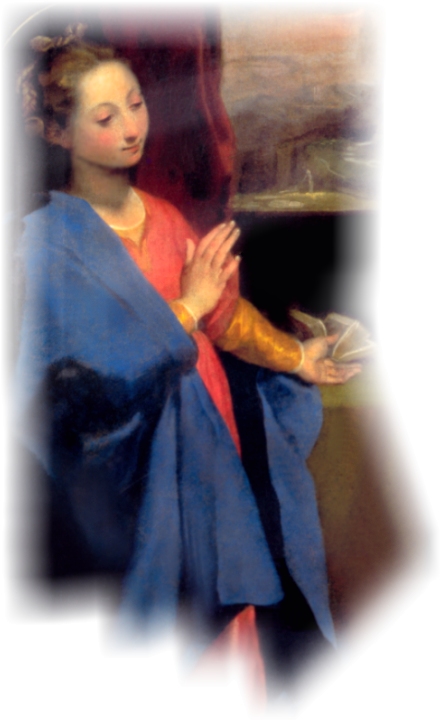
When the sixth month came, God sent the Angel Gabriel to a city of Galilee called Nazareth, where a virgin dwelt betrothed to a man of David's lineage; His name was Joseph, and the virgin's name was Mary. Into her presence the Angel came, and said, "Hail, thou who art full of grace; the Lord is with thee; Blessed art thou among women." She was much perplexed at hearing him speak so, And cast about in her mind, what she was to make of such a greeting. Then the Angel said to her, "Mary, do not be afraid; Thou hast found favor in the sight of God. And behold, thou shalt conceive in thy womb, and shalt bear a son and shalt call him Jesus. He shall be great, and men will know him for the Son of the most High; The Lord will give him the throne of his father, David, And He shall reign over the house of Jacob eternally; His Kingdom shall never have an end." But Mary said to the Angel, "How can that be, since I have no knowledge of man?" And the Angel answered her, "The Holy Spirit will come upon thee and the Power of the most High will overshadow thee.The Angel Gabriel, as God's spokesman, here asks Mary if she will freely give the Son of God a human nature, that He may also be the Son of man. A creature was asked by the Creator if she would freely cooperate with God's plan to take humanity out of the mire and to let him be ravished totally by God. Mary at first is troubled as to how she can give God a manhood, since she is still a virgin. The Angel settles the problem by telling her that God Himself, through His Spirit, will work that miracle within her.
Thus the holy thing which is to be born of thee shall be known for the Son of God."
But from our point of view there seems to be another difficulty. Mary was chosen by God to be His Mother and was even prepared for that honor by being preserved free from the primal sin that had infected all humanity. If she were so prepared, would she be free to accept or to reject, and would her answer be the full fruit of her free will? The answer is that her redemption was already completed but that she had not yet accepted or ratified it. It was, in a way, something like our dilemma. We are baptized as infants, and our bodies become temples of God, as our souls have been filled with infused virtues. We become not just creatures made by God but partakers in Divine nature. All this is done in Baptism before our freedom blossoms, the Church standing responsible for our spiritual birth as our parents did for our physical birth. Later on, however, we ratify that original endowment by the free acts of our moral lives — by receiving the Sacraments, by prayers, and by sacrifices. So, too, Mary's redemption was completed — as our Baptism was completed — but she had not yet accepted, ratified, or confirmed it before she gave her consent to the Angel. She was planned for a role in the drama of redemption by God, as a child is planned for a musical career by his physical parents, but it was not fulfilled until this moment. The Holy Trinity never possesses a creature without the consent of his will. When, therefore, Mary had heard how this was to take place, she uttered words that are the greatest pledge of liberty and the greatest charter of freedom the world has ever heard: "Be it done unto me according to thy word." As in Eden there took place the first espousals of man and woman, so, in her, there took place the first espousals of God and man, eternity and time, omnipotence and bonds. In answer to the question "Will you give me a man?" the marriage ceremony of love becomes bathed with new depths of freedom: "I will." And the Word was conceived in her.
Here, then, is freedom of religion; God respects human freedom by refusing to invade humanity and to establish a beachhead in time without the free consent of one of His creatures. Freedom of conscience is also involved: before Mary could claim as her own the great gifts of God, she had to ratify those gifts by an act of will in the Annunciation. And there is the freedom of a total abandonment to God: our free will is the only thing that is really our own. Our health, our wealth, our power — all these God can take from us. But our freedom he leaves to us, even in hell. Because freedom is our own, it is the only perfect gift that we can make to God. And yet here a creature totally, yet freely, surrendered her will, so that one might say that it was not a matter of Mary's will doing the will of her Son but of Mary's will being lost in that of her Son. Later on in His life he would say: "If the Son of Man makes you free, you will be free indeed." If this be so, then no one has ever been more free than this belle of Liberty, the lady who sang the Magnificat.
But there is another freedom revealed through Mary. In human marriage there is something personal and also something impersonal or racial. What is personal and free is love, because love is always for a unique person; thus, jealousy is the guardian of monogamy. What is impersonal and automatic is sex, since its operation is to some extent outside human control. Love belongs to man; sex belongs to God, for the effects of it are beyond our determination. Whenever a mother gives birth to a babe, she freely wills the act of love that made her and her husband two in one flesh. But there is also the unknown, the free element in their love, namely, the decision whether a child will be born of the union — whether it will be a boy or a girl and the exact time of birth and even the moment of its conception are lost in some unknown night of love. We are thus accepted by our parents rather than willed by them — except indirectly.
But with Mary there was perfect freedom. Her Divine Son was not accepted in any unforeseen or unpredictable way. He was willed. There was no element of chance; nothing was impersonal, for He was fully willed in mind and in body. How is this true? He was willed in mind, because, when the Angel explained the miracle, Mary said: "Be it done unto me according to thy word." Then he was willed in Body for now, not in some past obscure night; conception took place as in the full effulgence of the brightness of the morn does the Divine Spirit of Love begin weaving the garment of flesh for the Eternal Word. The time was deliberately chosen; the consent was voluntary; the physical cooperation was free. It was the only birth in all the world that was truly willed and, therefore, truly free.
Every birth partakes of the nature of the plant kingdom, in that the flower has its roots on the earth, although its blossoms open to the heavens. In generation, the body comes from parents who are of the earth; the soul comes from God, Who is in Heaven. In Mary, there was hardly any earth at all except herself; all was Heaven. The other love that conceived within her was the Holy Spirit; the Person born of her was the Eternal Word -— the union of the Godhead and manhood was through the mysterious alchemy of the Trinity. She alone was of earth, and yet she, too, seemed more of Heaven.
Other mothers know that a new life beats within them, through the pulsations within the body. Mary knew that Divine Life beat within her, through her soul in communion with an Angel. Other mothers become conscious of motherhood through physical changes; Mary knew through the message of an Angel and the overshadowing of the Holy Spirit. Nothing that comes from the body is as free as that which comes from the mind: there are mothers who yearn for children, but they have to wait upon processes subject to nature. In Mary alone a Child waited not on nature but on her acceptance of the Divine will. All she had to say was Fiat, and she conceived. This is what all birth would have been without sin-— a matter of human wills uniting themselves with the Divine will and, through the union of bodies, sharing in the creation of new life through the usual processes of human generation. The Virgin Birth is, therefore, synonymous with Birth in Freedom.
Mary! — we poor creatures of earth are stumbling over our freedoms, fumbling over our choices. Millions of us are seeking to give up their freedom — some by repudiating it, because of the burden of their guilt — some, by surrendering it to the moods and fashions of the time -— others, by absorption into Communism, where there is only one will, which is the dictator's, and where the only love is hate and revolution!
We speak much of freedom today, Mary, because we are losing it — just as we speak most of health when we are sick. Thou art the Mistress of Freedom because thou didst undo the false freedom that makes men slaves to their passions by pronouncing the word God Himself said when He made light and again when thy Son redeemed the world — Fiat! Or, be it done unto me according to God's will. As the "no" of Eve proves that the creature was made by love and is therefore free, so thy Fiat proves that the Creature was made for love as well. Teach us, then, that there is no freedom except in doing, out of love, what thou didst do in the Annunciation, namely, saying Yes to what Jesus asks.
VIEW THE FULL IMAGE BY BAROCCI

 E-MAIL
HOME-----------BACK TO THE ANNUNCIATION
www.catholictradition.org/Mary/annunciation5.htm